...Hallyu began roughly 12 years ago when the rest of Asia discovered Korean soap operas. One of the breakthrough dramas was a series 'Winter Sonata' starring Choi Ji-woo & Bae Young-Joon. After that, more Korean dramas saw their way to foreign shores and Korean films and music started to follow suit. Korean marketing people started to see a Korea-centric trend. They dubbed this flow "The Korean Wave" or Hallyu....
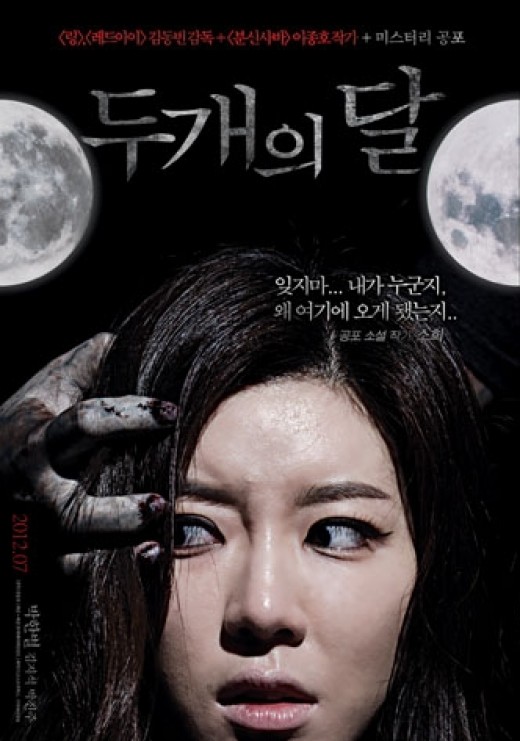
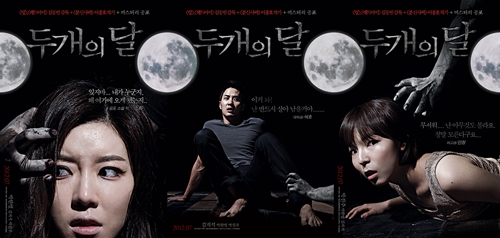
[News] Horror film "Two Moon" releases 3 posters of Kim Ji-seok, Park Han-byul, Park Jin-joo. Cr. - 10asia
Film distributor Lotte Entertainment has revealed three different posters of upcoming horror film, "Two Moon."
The film posters revealed on Thursday each features the three main actors -- actress Park Han-byul, actor Kim Ji-seok and actress Park Jin-joo -- with a scared look on their face.
The film is directed by Kim Don-bin whose works mainly include movies in the same genre such as "The Ring Virus" in 1999 and "Red Eye" in 2005.
Director Kim's third horror film, which is coming in seven years after the second one, begins by portraying a college student (played by Kim Ji-seok), a scripwriter (Park Han-byul) and a high school student (Park Jin-joo) all waking up in a mysterious house located in a remote area.
As the title of film infers, the story will focus on the day when two moons rise in the sky.
While "Two Moon" is actor Kim's first horror movie to star in, and the first film in two years after he has been discharged from his mandatory military service, it is Park Han-byul's third feature in the genre after appearing in "Wishing Stars" in 2003 and "Yoga" in 2009.
The officials said in the statement that "Two Moon" will be hitting the theaters sometime in July but the exact date has not been set yet.
[News] Bae Doo Na's Hollywood Actress-like Nature. Cr. - soompi
On September 6, actress Bae Doo Na was seen walking around famed Seoul Apgujeong District like a Hollywood actress (she'll be one soon by the way!).
She got out of her car to head into a hair salon. After a short time, she came out with a small shopping bag in hand.
One word to describe her style for the day: chic. Wearing a white boxy t-shirt and a striped skirt, she looked like she didn't spent any time on her outfit. She paired her casual attire with a white square bag.
Bae Doo Na's bare face and hair are what really made her stand out. Her skin was radiant and smooth looking, and her hair shone in the sun. The slightly ruffled hair and clean face gave her an effortless look. How hard is it to just walk out of your house with nothing on your face?
As she walked around outside, she was a free spirit. With an expressionless face, she went about doing her own things even though people recognized her on the streets. It seemed as if she was used to walking around alone. She was different in the sense that she drove and walked around by herself.
She will be leaving for Berlin soon for her next movie "Cloud Atlas" by the Wachowski Brothers, leaving Korea for another world. We will cheer you on Doo Na, Hwaiting!
[News] Song Hye Kyo's Film "Today" to Premier at Busan International Film Festival. Cr. - soompi
The film “Today” starring Song Hye Kyo will have its first premiere at the Busan International Film Festival. The distribution company of “Today” stated on September 16, “The film ‘Today’ has Lee Jung Hyang who directed ‘Art Museum by the Zoo,’ and ‘The Way Home” as the director and Song Hye Kyo as the heroine. The film was officially invited to premiere at the Gala Presentation of the Busan International Film Festival that will open in October.
The film will be released in theaters on September 27. The promotions for the film will begin on October 8 with a press conference and continue on with stage greetings, and discussions with the viewers.
The film “Today” is about a PD Dahae (Played by Song Hye Kyo) who decides to forgive a 17 year old boy who has killed her fiancé. The film is about the PD and her confusion and sadness that she goes through because of the results of having forgiven that boy, and also the end where she is moved.
[News] Photos Kindle Excitement for Jang Dong-gun War Movie. Cr. -englishnews@chosun.com
Dramatic photographs from the upcoming film "My Way" were released on Thursday, fueling high expectations for the movie.
The movie has been drawing attention since its inception as it marks the first time for actor Jang Dong-gun and director Kang Je-gyu to work together since their 2004 blockbuster "Taegukgi: The Brotherhood of War.
"My Way" tells the story of two men's intertwined destinies and their friendship against the background of World War II.
Shooting started in October with a budget of W30 billion (US$1=W1,114), the largest in Korean film history. The movie, which also features Japanese film star Joe Odagiri and Chinese actress Fan Bingbing, is scheduled to be released in December.
ผลงานภาพยนตร์ : A Time to Love / 情人结 (2005) Goddess Of Mercy / 玉关音 (2004) ศึกอหังกา นักรบเทวดา / Warriors of Heaven and Earth / 天地英雄 (2003) Grean Tea / 绿茶 (2003) กิ๊กรัก คุณหนูกำมะลอ / My Dream Girl / 炮制女朋友 (2003) 3 พยัคฆ์สาวมหาประลัย / So Close / 夕阳天使 (2002) Chinese Odysseey 2002/ 天下无双 (2002) นักเตะเสี้ยวลิ้มยี่ / Shaolin Soccer/ 少林足球 (2001) พายุดาบดวลสะท้านฟ้า / The Duel / 决战 (2000) รักนี้ไม่มีกำมะลอ / Deja Vu / 缘份2000 (1999) Penitentiary Angel / 女儿谷 / 落难肖佳人 (1997) East Palace,West Palace / 东宫西宫 (1997) La Peintre / 画魂 (1994)
ผลงานละคร : Moment in Peking / 京华烟云 (2005) มนต์รักในสายฝน / Romance in the Rain / 情深深,雨蒙蒙(2001) นางพญาเย้ยฟ้าท้าดิน / Treaser Venture/ 侠女闯天关 (2000) องค์หญิงกำมะลอ ภาค 2 / Princess Returning Pearl II / 还珠格格(1999) Kang Xi Incognito Travel II - Tale of Longan / 康熙微服私访记 (1998) เราสองหัวใจเดียวกัน / Cousin Ji Xiang (Old House Has Joy) / 表妹吉祥 / 老房有喜 (1998) องค์หญิงกำมะลอ ภาค 1 / Princess Returning Pearl I / 还珠格格 (1997) Big Square / 大魔方(1997) Sister ‘Advanture in Beijing / 姐姐妹妹闯北京(1996)
ผลงานเพลง :
Piao (2004) Vicki New & Best (2001) Magic Of Love(1999) Swallow(1999)
Vicki Zhao / Zhao Wei ( 赵薇 ) Zhao Wei is a Chinese film actress and pop singer. Audiences sometimes refer to her by her English name, Vicki Zhao. She is considered one of the "Four Young Dan actresses" in China (四小花旦), along with Xu Jinglei, Zhang Ziyi and Zhou Xun.
After being chosen to work as an extra on a filming set, Zhao developed a passion for acting. While studying at Beijing Film Academy, Zhao participated in various film projects. Zhao's breakout role as a leading actress was in Princess Pearl, a television series. In 1999, after Princess Pearl was broadcast, Zhao also began a singing career with her first album, Swallow. After her breakthrough, Zhao has been involved in numerous controversies about her personal and professional lives, including posing in a dress resembling a Japanese war flag.
Throughout her career, Zhao has engaged herself in more varied roles, such as Lu Yiping in Romance in the Rain, a policewoman named An Xin in Jade Goddess of Mercy, the playful Qu Ran in A Time to Love, and the gentle, intelligent Yao Mulan Moment in Peking. She has also remained active in her music, recording several albums since her debut in 1999.
Painted Skin (2008) The Battle of Red Cliff (2008) The Longest Night in Shanghai (2007) The Postmodern Life of My Aunt (2006) A Time to Love (2005) Jade Goddess (2004) My Dream Girl (2003) Green Tea (2003) Warriors of Heaven and Earth (2002) Chinese Odyssey (2002) So Close (2001) Shaolin Soccer (2001) The Duel (2000) Deja Vu (1999) Penitentiary Angel (1999) East Palace, West Palace (1996) La Peintre (1994)
TV Series Theme Songs :
Bu Yao Ba Wo Shou Fang Kai (不要把我手放开) Don't Let Go of My Hand, Fast Track Love ending theme song (2006) Qing Shen Shen Yu Meng Meng (情深深雨濛濛), Romance in the Rain opening theme song (2001)
Reflection – OST. “Mulan” (1998) / Christina Aguilera
Look at me, you may think you see Who I really am But you’ll never know me Every day, is as if I play apart Now I see, if I wear a mask I can fool the world But I cannot fool…my heart
Who is that girl I see Staring straight back at me? When will my reflection show Who I am inside?
I am now, in a world where I have to Hide my heart And what I believe in But somehow, I will show the world What’s inside my heart And be loved for who I am
Who is that girl I see Staring straight back at me? Why is my reflection show Someone I don’t know?
Must I pretend that I’m, Someone else for all time? When will my reflection show Who I am inside?
There’s a heart that must be free to fly That burns with a need, To know the reason why, Why must we all conceal What we think How we feel Must there be a secret me I’m forced to hide? I won’t pretend that I’m someone else, For all time
Mu-Lan, the Chinese Woman Warrior By Elisabetta LeJeune
Outline : Thesis statement:"The Ballad of Mulan" has inspired many Chinese women to defy traditional gender roles. I. "The Ballad of Mulan" has experienced a resurgence of popularity as Disney is making it the story of his latest animated feature. In the last five years the traditional Chinese poem has been published in various versions of children books. II. Summary of the poem III. Yueh Fu poetry IV. Historical background V. Significance of the poem in the context of Chinese literature
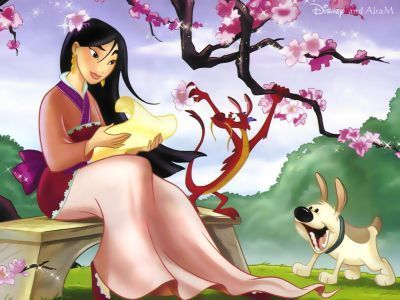
The recently released Disney movie Mulan portrays the Chinese heroine Mu Lan who disguised herself as a man to serve in the imperial army in place of her father. The movie is based on an ancient popular Chinese ballad which dates to the fifth century A.D. and which has been popular throughout the centuries. In 1993 China's Bravest Girl: the Legend of Hua Mu Lan told by Charlie Chin was published by the Children' Book Press followed in 1995 by The Song of Mu Lan by Jeanne M. Lee. In these two versions, the original poem is published alongside in the original Chinese (Kuo). Publishers Weekly reviewed both books and pointed out that "a simple rhyming text keeps the pace brisk in this adaptation of a fifth-century Chinese legend about a young woman who goes to war to save her family's honor". Several other books were published in 1998, the year the Disney's movie was released. Fa Mulan: The Story of a Woman Warrior, written by Robert San Souci, is the retelling of the original Chinese poem that inspired the Disney movie. "Children's book author Robert San Souci, a frequent Disney consultant, had suggested that a Chinese poem called 'The Song of Fa Mu Lan' might make good movie," report Brown, Corie and Laura Shapiro.
The original poem was written in the form of "yueh-fu" poetry by a woman named Tzu-Yeh. A translation of the Chinese poem appears in Han Frankel's book The Flowering Plum and the Palace Lady: Interpretations of Chinese Poetry, which was published in 1976. In the poem Mu-lan seems disinterested in women's chores and not ready to be married. She is rather worried about the draft which calls for each family to send a son or brother to serve the army. Quickly Mulan purchases the required equipment: a horse, a saddle, a bridle, and a long whip. She then joins the evening camps and leaves for the long journey. The refrain of the song repeats that, "She does not hear the sound of Father and Mother calling." Ten years she is gone on a journey of ten thousand miles. Then she sees the Son of Heaven, the Khan, and when he asks her what she desires as reward for those years of service, she just asks to go home. She is welcome by all her family with the addition of a Little Brother. It does not take long for Mu-lan to get back her true identity; she finds her rooms and her old clothes and resumes her feminine appearance. She attends to her appearance by fixing her hair, by now cloudlike, maybe white after those years of hard work and sacrifice. She also puts powder on her face and then goes out to see her comrades who had shared all those years on the battlefield with her. They are "amazed and perplexed" to find out that Mu-lan is a woman. The last four lines of the poem quote a reference to a male and a female hare pointing out how it is impossible to tell the sex difference when they are "running side by side close to the ground."
The poem is composed in the song form of "Yueh-fu." This style was derived from folk songs, often narrative poems accompanied by music. In 120 B.C. Emperor Wu set a Bureau of Music to provide musical entertainment during sacrifices. The officials of the bureau would collect folk songs from various parts of the country to provide inspiration for their work. Many songs in this style were imitations of those popular ballads. They were characterized by "formulaic expressions, free rhythmic patterns, often in lines of irregular length" (Chang 211). This style flourished during the Han Dynasty from 120 A.D. until 580 A.D. Many anonymous ballads are recorded in later works said to date from Han times, a dynasty which spans over 400 years (Watson 289). The Yueh-fu songs were later replaced by the tz'u form when literate poets composed new music to replace the popular music. Chang presents an example of the unclear transition between the two forms:
It can be imagined that there must have been some generic confusion between tz'u and yueh-fu at this time, especially because tz'u tunes were at first seen as new yueh-fu tunes. A telling case is Wen T'ing-yun's Yueh-fu poem Ch'un-hsiao ch'u. which also appears in his tz'u collection under the title Mu-lan hua.
While it is difficult to say whether any of these folk songs survive, certainly the ballad of Mulan has a long story of popularity. The legend of Mulan was the subject of subsequent literary works. It was developed into a novel during the late Ming (A.D. 1368-1644) Dynasty (Kuo). Mulan also became the heroine of a play by Xu Wei, who called her Hua Mulan.
The name Mu-lan appears in different spelling versions. Some sources spell her name with a hyphen and others without. In the poem the name is simply Mu-lan, but it has also been spelled as Hua Mu-lan in a collection of tzu' poems (Chang 12). The translation of "Mulan" is magnolia. "Mu" means "wood" and "Lan" means "orchid," while Hua means flower. In Chinese last names come first. Therefore, the word Hua can be considered a last name. In other sources the surname is Fa, as in Fa Mu Lan.
In China Hua Mulan is a symbol of heroic behavior. There is no certain evidence to support whether she really existed. The place of origin or the period when she lived are also not agreed upon. According to an article devoted to Mulan and part of a web site that celebrates 100 Chinese women:
One thing seems certain though. Hua Mulan was from the region known as the Central Plains. Cheng Dachang of the Song Dynasty recorded that Hua Mulan lived during the Sui and the Tang Dynasties. Song Xiangfeng of the Qing Dynasty asserted that she was of Sui origins (AD 581-618) while Yao Ying, also of the Qing Dynasty, believed she was from the time of the Six Dynasties. No record of her achievements appears in official history books prior to the Song times. Stories circulated in China's Central Plains indicate that she must have lived before the Tang Dynasty. ("100 Celebrated Asian Women")
The legend of Mulan is an example of stories of women characters who take the non traditional role of warrior. This figure that defies traditional role models had been a source of inspiration for young Chinese girls. Maxine Hong Kingston narrates the powerful memories that she recalls of growing up in a Chinese-American family. In her book The Warrior Woman: Memoirs of a Girlhood among Ghosts she tells how the story of Fa Mu Lan has symbolized the power of warrior women:
At last I saw that I too had been in the presence of great power, my mother talking-story. After I grew up, I heard the chant of Fa Mu Lan, the girl who took her father's place in battle. Instantly , I remembered that as a child I had followed my mother about the house, the two of us singing about how Fa Mu Lan fought gloriously and returned alive from war to settle in the village. I had forgotten this chant that was once mine, giving me by my mother, who may not have known its power to remind. She said I would grow up to be a wife and a slave, but she taught me the song of the warrior woman, Fa Mu Lan. I would have to grow up a warrior woman.
Cultural awareness in Disney's Mulan for the elementary school students in Taiwan : an action research on muticultural education Tamkang University Institutional Reponsitory
On June 8, 1998, the Walt Disney Company released the 36th animated film Mulan, which is an adaptation based on a Chinese poem, usually known as The Legend or The Ballad of Mu-lun. This poem, by an anonymous writer of the Southern and Northern dynasties (A.D. 420-581), has been popular for generations in China and was collected in Yuefu, the Song dynasty compendium of lyrics, songs and poems. As Disney’s Mulan is an adaptation of a legendary story remotely set in ancient China, it raises issues such as the authenticity and accuracy of Chinese culture values and facts. Critique has it that the issues of cultural authenticity and cultural accuracy become particularly important if the purpose is to evaluate the film Mulan as an art/literary work for young viewers and to investigate its influence upon children in terms of multicultural education. Particularly under the circumstances of the innovation and development of this century’s media, children’s literature has not been confined to paper books. Children often watch video tapes before they read a story if there is one available. Schoolteachers usually adopt Disney’s animated films as a motivating approach to usher children into the world of classic children’s literature. Therefore, it is crucial for schoolteachers and parents to take Mulan seriously and carefully whether to incorporate into school’s curriculum. Educators should be alert to the offensive, racially-coded language and cultural clichés presented in Mulan and discuss the stereotype and cultural distortions in Mulan with children.
Consequently, the purpose of this action research includes:
(1) to investigate students’ opinions toward Disney’ Mulan. Can they be aware of the stereotype, distortions and misinterpretations of Chinese culture in “Mulan”?
(2) to guide students to analyze and deconstruct Mulan in the perspectives of cultural authenticity and cultural accuracy so as to inspire students the importance of Chinese cultural awareness.
(3) Seeing that Disney’s treatment of Mulan can not reflect the authenticity and accuracy of Chinese culture seriously and honestly, students should take this case as a profound lesson, that is to say, try not to misinterpret or distort when dealing with multicultural issues. An attitude with respect, admiration, and heart always alike is needed when facing any micro or macro cultures if the purpose is to enhance students’ cultural learning and global understanding and establish a harmonic world in the long run.
The major findings of this study are given as follows: 1. Students can not be aware of the stereotype, distortions and misinterpretations of Chinese culture in Mulan before the researcher intervenes to inspire them the importance of Chinese cultural awareness. 2. As the development of activities, students can analyze and deconstruct Mulan in the perspectives of cultural authenticity and cultural accuracy little by little. 3. Students’ cultural awareness has changed from the state of invisibility to visibility. 4. To take Mulan for example, students can present a positive and constructive attitude to cope with multicultural issues. 5. As to the core value of multiculturalism, cultural learning and global understanding, students can gain the knowledge of both eastern and western philosophical concepts at the same time, that is to say, understand the reason why Disney animators interpret Chinese legendary story Hua Mu-lan in this way in “Mulan” and re-examine their awareness toward Chinese culture so as to expand their cultural experience and field of vision.
Description: 碩士 Appears in Collections:[美國研究所] 學位論文
Hua Mulan is a heroine who joined an all-male army, described in a famous Chinese poem known as the Ballad of Mulan. The poem was first written in the Musical Records of Old and New from the 6th century, the century before the founding of the Tang Dynasty; the original work no longer exists, and the original text of this poem comes from another work known as the Music Bureau Collection, an anthology of lyrics, songs, and poems, compiled by Guo Maoqian during the 12th century. The author explicitly mentions the Musical Records of Old and New as his source for the poem. Whether she was a historical person or whether the poem was an allegory has been debated for centuries—it is unknown whether the story has any factual basis.
Overview : In the story, Mulan disguised herself as a man to take her elderly father's place in the army. She was later offered a government post by the emperor himself after her service was up. However, unwilling to commit anymore to the forces, she turned down the position so she could return to her family immediately. When her former colleagues visited her at home, they were shocked to see her dressed as a woman. The poem ends with the image of a female hare (Mulan) and a male hare (her comrades) running side by side, and the narrator asking how anyone could tell them apart.
The time setting of the story is uncertain. The earliest accounts of the legend state that she lived during the Northern Wei dynasty (386–534). However another version reports that Mulan was requested as a concubine by Emperor Yang of Sui China (reigned 604–617). Evidence from the extant poem suggests the earlier interpretation.
The poem is a ballad, meaning that the lines do not necessarily have equal numbers of syllables. The poem is mostly composed of five-character phrases, with just a few extending to seven or nine.
There are three uses of onomatopoeia in the poem. The sound of Mulan's weaving (or her lamentations) is 唧唧 jī-jī (i.e., "click-clack"); the Yellow River babbles 溅溅 jiān-jiān (i.e., "splish-splash") to her as she departs from it; at the military encampment the horses cry 啾啾 jiū-jiū (i.e., they whinny).
The story was expanded into a novel during the late Ming Dynasty (1368–1644). Over time, the story of Hua Mulan rose in notoriety as a folk tale among the Chinese people on the same level as the Butterfly Lovers. In 1998, Disney released an animated movie entitled Mulan very loosely based on the story.
Name : The word mulan refers to the "Magnolia liliiflora". (mù by itself means "wood" and lán means "orchid".) The heroine of the poem is given many different family names in the various versions of her story. According to History of the Ming, her family name is Zhu, while the History of the Qing say it is Wei. The Ballad of Mulan doesn't give her family name. The Ming scholar Xu Wei offers yet another alternative when, in his play, he gives her the family name Huā (meaning "flower"). This latter name has become the most popular in recent years in part to its more poetic meaning. Her complete name is then 花木兰, transcribed as Huā Mùlán in Pinyin and Hua1 Mu4-lan2 in Wade-Giles.
The Disney animated film popularised the version "Fa Mulan". This "Fa" pronunciation of 花 is found in various Chinese languages including Cantonese, while "Mulan" is the phonetic translation from Mandarin.
Hua Mulan in popular culture : English language literature Maxine Hong Kingston re-visits Mulan's tale in her text, The Woman Warrior. Yao Mulan, Lin Yutang's main character in his English novel Moment in Peking, is named after the legendary warrior.
In the alternative-history fantasy series Temeraire, by Naomi Novik, specifically, the book Throne of Jade, the legend of Mulan is (indirectly) referred to, as a woman taking her father's place in the military, taking the role of an aerial commander on dragonback. In deference to this honored legend, all officers in the Chinese Aerial Corps are women, which sets it apart from the English Corps, which uses female officers only for Longwings, a dragon breed which refuses male captains. In The Dragonstone by Dennis McKiernan, the character Aiko is a Hua Mulan inspired warrior who sneaks off to battle against imperial decree.
Movie Film : The story of Hua Mulan has inspired a number of film and stage adaptations without taking into account pre-modern Chinese plays and operas about the subject. These include the following:
Hua Mulan Joins the Army (1927 film) - a Chinese silent film released by the Tianyi Film Company and directed by Li Pingqian
Mulan Joins the Army (1928 film) - Mingxin Film Company production, directed by Hou Yao. The film was unsuccessful, in part due to the Tianyi film that was released the previous year
Mulan Joins the Army (1939 film) - popular Chinese film made during the war, directed by Bu Wancang
Hau Mu Lan (1964 film) - Hong Kong opera film
Mulan (1998 film) - Disney animated feature based on the Mulan legend
"Mulan 2" (2004 film) - Disney animated sequel following Mulan
Hua Mu Lan (1999 series) - Taiwan CTV period drama serial starring Anita Yuen as Hua Mu Lan
Miscellaneous : Hua Mulan Crater on Venus is named after her. A character inspired by Hua Mulan is the mascot of the FIFA Women's World Cup 2007 in China. New Tang Dynasty TV's 2006 Chinese Spectacular featured a stage performance of the story of Mulan. Hua Mulan was included as a card in the Anachronism card game by TriKings.[1] In 2005–2006, the Disney movie was replicated as a playable world in the video game Kingdom Hearts II. In the Discovery Channel series "Warrior Women", aptly hosted by actress Lucy Lawless, the legend of Mulan is referenced as having been inspired by the true story of Chinese female general Wang Cong'er.
Tsiek tsiek and again tsiek tsiek, Mu-lan weaves, facing the door. You don't hear the shuttle's sound, You only hear Daughter's sighs. They ask Daughter who's in her heart, They ask Daughter who's on her mind. "No one is on Daughter's heart, No one is on Daughter's mind. Last night I saw the draft posters, The Khan is calling many troops, The army list is in twelve scrolls, On every scroll there's Father's name. Father has no grown-up son, Mu-lan has no elder brother. I want to buy a saddle and horse, And serve in the army in Father's place."
In the East Market she buys a spirited horse, In the West Market she buys a saddle, In the South Market she buys a bridle, In the North Market she buys a long whip. At dawn she takes leave of Father and Mother, In the evening camps on the Yellow River's bank. She doesn't hear the sound of Father and Mother calling, She only hears the Yellow River's flowing water cry tsien tsien.
At dawn she takes leave of the Yellow River, In the evening she arrives at Black Mountain. She doesn't hear the sound of Father and Mother calling, She only hears Mount Yen's nomad horses cry tsiu tsiu. She goes ten thousand miles on the business of war, She crosses passes and mountains like flying. Northern gusts carry the rattle of army pots, Chilly light shines on iron armor. Generals die in a hundred battles, Stout soldiers return after ten years.
On her return she sees the Son of Heaven, The Son of Heaven sits in the Splendid Hall. He gives out promotions in twelve ranks And prizes of a hundred thousand and more. The Khan asks her what she desires. "Mu-lan has no use for a minister's post. I wish to ride a swift mount To take me back to my home."
When Father and Mother hear Daughter is coming They go outside the wall to meet her, leaning on each other. When Elder Sister hears Younger Sister is coming She fixes her rouge, facing the door. When Little Brother hears Elder Sister is coming He whets the knife, quick quick, for pig and sheep. "I open the door to my east chamber, I sit on my couch in the west room, I take off my wartime gown And put on my old-time clothes." Facing the window she fixes her cloudlike hair, Hanging up a mirror she dabs on yellow flower powder She goes out the door and sees her comrades. Her comrades are all amazed and perplexed. Traveling together for twelve years They didn't know Mu-lan was a girl. "The he-hare's feet go hop and skip, The she-hare's eyes are muddled and fuddled. Two hares running side by side close to the ground, How can they tell if I am he or she?"
From:The Flowering Plum and the Palace Lady: Interpretations of Chinese Poetry By Han H. Frankel, Yale University Press, 1976.
-----------------------------
Rough translation from Chinese:
The insects chirping happily outside, Mulan sat opposite the door weaving; No sound of the shuttle was heard, Only sighs of the girl. When asked what she was pondering over, When asked what she had called to mind, Nothing special the girl was pondering over, Nothing special had the girl called to mind. Last night she saw the military announcement, The Emperor was conscripting, There were twelve announcements of conscription, And Father's name was in every one of them. Father had no grown son, Nor Mulan an older brother; She wanted to buy a saddle and horse, And from now on fought in place of her Father. In the eastern market she bought a fine steed, In the western market a saddle and a pad, In the southern market a bridle, In the northern market a long whip. At daybreak she bid farewell to her parents, At sunset she bivouacked by the Yellow River; What met her ears was no longer her parents' call, But the gurgles and splashes of the rushing waters. At daybreak she left the Yellow River, At sunset she arrived at the top of the Black Hill; What met hers ears was no longer her parents' call, But barbarians' horses neighing in the Yanshan Mountains. On the expedition of thousands of miles to the war, She dashed across mountains and passes as if in flight; In the chilly northern air night watches clanged, In the frosty moonlight armour and helmet glistened, Generals laid down their lives in a hundred battles, And valiant soldiers returned after ten years' service. When she returned to an audience with the Son of Heaven, The Son of Heaven sat in the Hall of Brightness. A promotion of many ranks was granted for her merits, With a reward than amounted to thousands of strings of cash. The Khan asked Mulan what she desired to do. 'I don't need any high official position, Please lend me a sturdy mount that is fleet of foot, And send me back to my hometown.' When her parents heard their daughter was coming, They walked out of the town, each helping the other; When the elder sister heard the younger sister was coming, She decked herself out in her best by the door; When her younger brother heard his sister was coming, He whetted a knife and aimed it at a pig and a sheep. Opened the door of my east chamber, And then sat down on the bed in my west chamber; Taking off the armour worn in wartime, Attired myself in apparel of former times; By the window I combed and coiffed my cloudy hair, Before the mirror I adorned my forehead with a yellow pattern. When Mulan came out to meet her battle companions, They were all astounded and thrown into bewilderment. Together they had been in the army for a dozen years or so, Yet none had known that Mulan was actually a girl. The male rabbit kicks its fluffy feet as it scampers, The eyes of female rabbit are blurred by fluffy tufts of hair, But when they run side by side in the field, You can hardly tell the doe from the buck!
Mulan Movie Trailer with Russian singer, Vitas and Zhao Wei
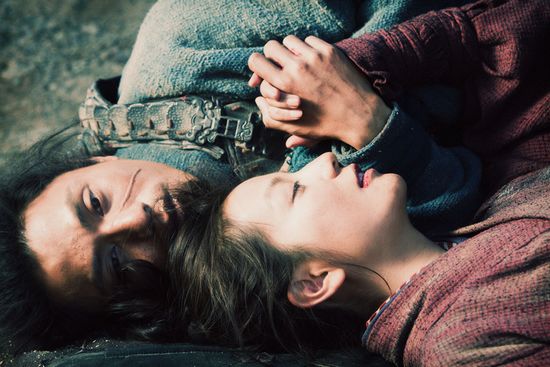
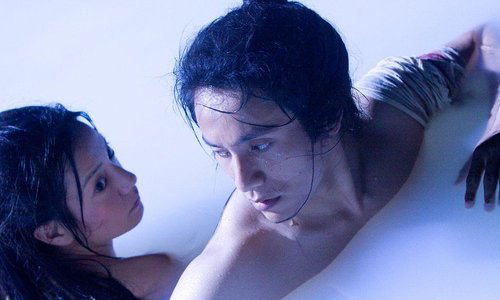
Mulan, known in Chinese as Hua Mulan (花木蘭), is a 2009 Chinese film starring Zhao Wei as the legendary Hua Mulan. The director, Jingle Ma, has explained that this movie is vastly different from the Disney Cartoon Film and adheres more to his imagination. Zhao Wei was cast by Ma as the titular Mulan in favor of actresses Zhang Ziyi, Michelle Yeoh, and Liu Yifei, who were reportedly also considered for the role.
The film also features a cameo by the Russian singer, Vitas, who also helped publicize the film by providing a song entitled "Beneath the Glory" for the film score.
Mulan follows the Chinese folktale of Hua Mulan (Zhao Wei), about a young woman who dresses as a man to fight in the war in place of her father. At the start of the film, Mulan lives with her aging father, a former soldier for the Northern Wei dynasty. One day, envoys from the emperor arrive, announcing that an army is being mustered to fight off an invasion by the Rouran. As her father prepares to again go to war, Mulan, in the middle of the night, takes his armor and his sword and takes his place.
In camp, she meets and befriends several other soldiers, including Xiaohu (Jaycee Chan), a fellow villager who recognizes Mulan but promises to keep her gender a secret. She also meets Wentai (Chen Kun), an officer who takes a liking to the young soldier.
Mulan's identity is at jeopardy, however, when Mulan admits to stealing a jade pendant owned by another soldier to avoid participating in a strip search. Scheduled for execution, she is only saved when Wentai loosens her binds during a surprise attack by Rouran. Rather than escaping, Mulan proves her bravery when she turns the tide of battle by killing the enemy general. Mulan's exploits are rewarded and she and Wentai are promoted through the ranks of the army, eventually reaching the status of general.
Despite their victories, Wentai realizes that Mulan is still too emotionally attached to both himself and to her men, and fakes his death during an ambush by the Rouran. Hiding in the medical tent, Wentai watches as Mulan first falls into deep despair before eventually overcoming her grief to become one of the emperor's finest officer.
After twelve years of fighting, the Rouran is near a breaking point. The son of the Rouran Dayan, Mendu (Hu Jun) nevertheless still thirsts for power and kills his less ambitious father to take the Rouran crown. Gathering an army of 200,000, he invades the Wei heartland once more. In response, Mulan develops a plan that will trap and eventually destroy the invasion, despite the Rouran superiority in men and supplies. She is give command of 20,000 soldiers and wins an early victory before retreat to a canyon. Awaiting support from the commander in chief of the Wei forces, she eventually finds herself betrayed by her superior when no supplies and no support is forthcoming. With an army slowly dying from thirst and wounds, Mulan prepares for a martyr's death when Wentai reveals himself to the Rouran as a prince of Wei, and offers himself in exchange for the safety of Mulan and her soldiers.
As Mulan’s soldiers retreat, she disguises herself as a Rouran soldier and sneaks into their camp. Mulan confronts Rouran princess who dreams of peace between the Wei and the Rouran nations. She convinces the Rouran princess to aid her, and the two assassinate Mendu and rescue Wentai. Mulan returns to the Wei capital where she at last reveals herself as a woman and not a man. The Wei emperor nevertheless rewards her and announces that his son, Weitai, will marry the Rouran princess to bring peace to the lands. Mulan asks only to return to her native village. Later, Wentai pays a visit to Mulan’s village and asks her to elope with him. Mulan, however, convinces Wentai the necessity of sacrificing for their country. Understanding this, Wentai sadly leaves the village.
The Fact
Hua Mulan is a heroine who joined an all-male army, described in a famous Chinese Poem known as the Ballad of Mulan. The poem was first written in the Musical Records of Old and New from the 6th century, the century before the founding of the Tang Dynasty; the original work no longer exists, and the original text of this poem comes from another work known as the Music Bureau Collection, an anthology of lyrics, songs, and poems, compiled by Guo Maoqian during the 12th century. The author explicitly mentions the Musical Records of Old and New as his source for the poem. Whether she was a historical person or whether the poem was an allegory has been debated for centuries — it is unknown whether the story has any factual basis.
The time setting of the story is uncertain. The earliest accounts of the legend state that she lived during the Northern Wei dynasty (386–534) but there has been no proof. However another version reports that Mulan was requested as a concubine by Emperor Yang of Sui China (reigned 604–617). Evidence from the extant poem suggests the earlier interpretation.
The story was expanded into a novel during the late Ming Dynasty (1368–1644). Over time, the story of Hua Mulan rose in popularity as a folk tale among the Chinese people on the same level as the Butterfly Lovers. In 1998, Disney released an animated movie entitled Mulan based on the story.
Vitas: OPERA#2 with english lyrics
About Vitas
Vitaliy "Vitalik" Vladasovich Grachyov (Russian: Виталий Владасович Грачёв, Vitalij Vladasovič Gračëv; born 19 February 1979, Daugavpils, Latvian SSR), better known by his stage name Vitas (pronounced /ˈviːˌtɑːs/) is a Russian pop singer, composer, actor, and fashion designer. Because of his fame on the Internet, he is sometimes known as Bumac, Bumac Vitas or Vitas Varnas in English.
His 2000 song, "Opera No. 2" ("Opera #2"; released as a single in 2001) has been forwarded frequently via the internet, which accounts for much of his worldwide recognition. His eclectic pop music is often difficult to categorise, incorporating elements of techno, dance, classical, jazz, and folk music. He designs his own stage costumes. DIVA (ДИВА) is the name of the band that accompanies Vitas during his concerts.
Vitas has achieved much of his fame through Russian television, and since 2005 his career has advanced into Asian markets. He has signed with entertainment labels such as Universal which distributes his music in Taiwan, and he has toured extensively in China and several other countries. He has performed duets with many other singers including Demis Roussos, Lucio Dalla, and Vitas' grandfather Arkadiy Davydovich Marantsman (Аркадий Давыдович Маранцман), with whom he sings "Friendship".